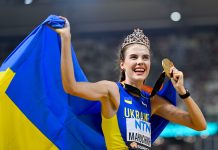
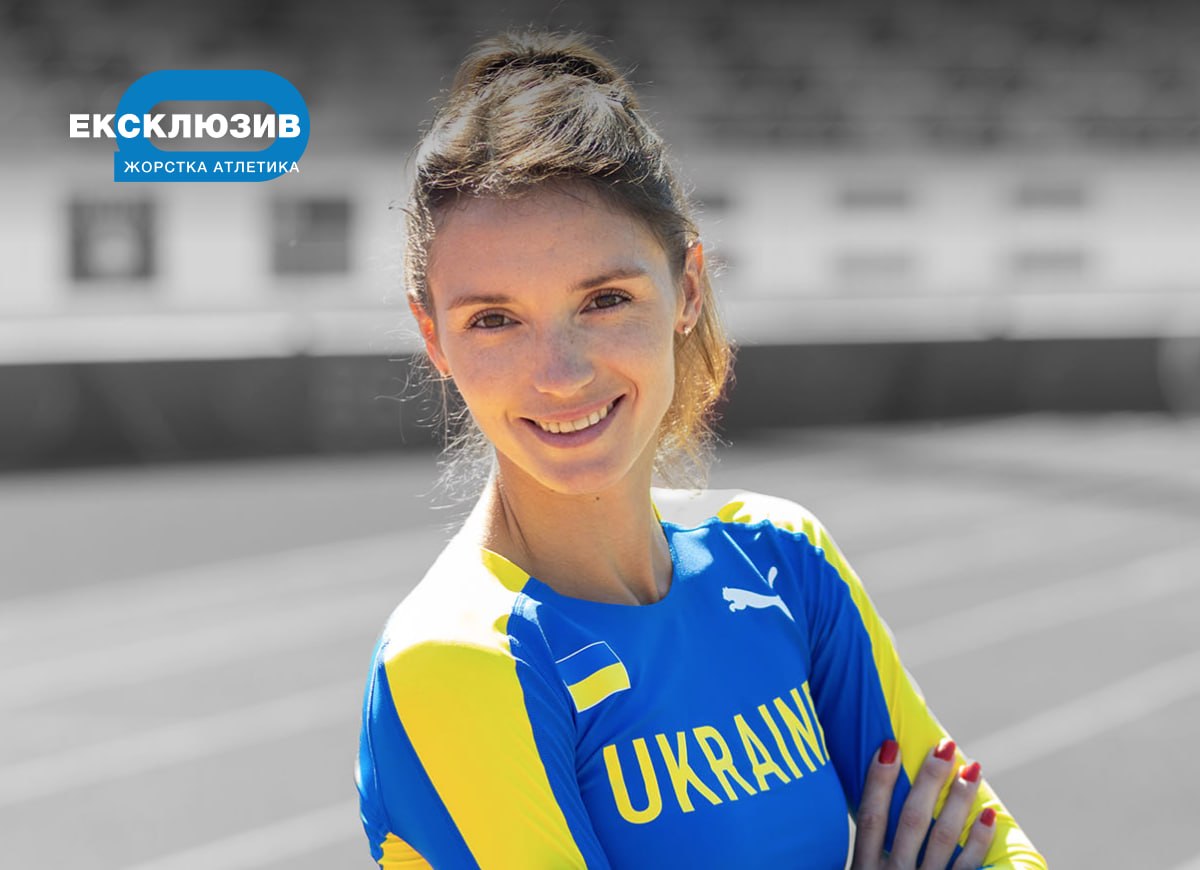
Ukraine’s most decorated race walker, Lyudmyla Olyanovska, recently added another major achievement to her collection, winning team gold at the World Race Walking Team Championships over the half marathon distance. She claimed victory in Brazil alongside Hanna Shevchuk and Mariia Sakharuk.
Following the triumph, Olyanovska spoke about the challenges behind the medal, her views on changes in race walking distances, why she rejected offers to compete for other countries, and the goals she still considers unfinished.
“Two laps before the finish, I felt like I might collapse”
– Lyudmyla, you mentioned that this gold medal didn’t come easily. What made it so difficult?
– First of all, I made it to the World Championships without going through the national selection. I missed the Ukrainian Championships, which served as qualification, because I got sick. After a very intense and successful indoor season, just three days before the start I developed a fever. We decided not to take risks or act heroically, so we submitted a request to allow me to compete without selection.
Recovery wasn’t easy, and soon after I traveled to Brazil for a training camp. Acclimatization was crucial — we essentially went from winter straight into +26…+28°C.
Another key factor was altitude — about 1,100 meters above sea level. It was my first time competing in such conditions. It’s very specific: even if you’re well prepared, your body can react suddenly. It’s not a gradual slowdown — you’re moving fine, and then suddenly you’re “cut off” and just trying to survive to the finish.
We focused more on adapting than on intense training. We trained early in the morning and stayed in shaded areas.
But during the race itself, everything felt different. Even in the warm-up, I could tell something was off — my ears were blocked like on a plane, and my heart rate spiked even with small accelerations.
The women’s race started at 12:50 — in peak heat, under direct sun. That was the toughest part. For the first 10–12 km I stayed with the lead group and felt relatively in control. Then came the moment when the body just “switches off.”
You can hear instructions, but you can’t react. Your legs feel like cotton, your arms lose rhythm, your whole body refuses to work. I knew there were two laps left, but it felt like I might collapse — everything was blurry.
At that moment, our head coach shouted that I needed to catch the Italian athlete because we lacked points in the team standings. Despite everything, I had to push — and I managed to pass her at the finish.
Maybe it wasn’t decisive against the main rivals — Australia and Spain — but at that moment it was crucial for the team.
Our victory came down to consistency. In team standings, places are added together.
We needed to finish as close to each other as possible — and as high as possible. That consistency became our advantage.
I can say I was lucky to be part of this team. We were all at a similar level of readiness, and together we were very strong.
– What emotions did you feel when you realized the Ukrainian national anthem was about to be played?
– For me, it’s not the first time hearing the Ukrainian anthem at international competitions, but every time it brings special emotions. It’s always incredibly moving. I always sing along, and I want it to be heard as often as possible — louder and across the whole world.
And not only in our sport or at the Olympic Games, but in general — I want Ukraine to win everywhere.
When we were heading to this team championship, I think each of us made a promise — to ourselves, to the team, and to our coaches — that we would give everything we had. And I believe we truly delivered our maximum in those conditions.
Although, if we look purely at the final half marathon times, this might not have been our strongest performance. So there’s definitely still room for improvement and an understanding that we can be even stronger.
On distance changes: “This is the wrong direction”
What do you think about the change in race walking distances to the marathon and half marathon?
– Historically, race walking was built around 20 km and 50 km. The 50 km was a symbol of extreme endurance — a distance for true “titans.” People dedicated their lives to it.
The 20 km is a classic Olympic event and should remain unchanged.
It creates the impression that race walking is gradually being pushed out of the program of major competitions. For example, the discipline is still included in the Olympic Games in Los Angeles, but there is no certainty yet regarding the Brisbane 2032 Games.
The 50 km was removed, replaced by 35 km, which has also effectively disappeared. Now we have a mixed relay — but its format raises many questions. If it were something like a 4×10 km relay, that would make more sense. But now it’s 42 km split between two athletes over four legs, with long recovery breaks in between. It’s unnatural for the body.
In terms of results, there are no significant changes. Speeds remain roughly the same as in the 20 km — women who used to walk at 4:20–4:18 per kilometer will maintain that pace over the half marathon distance as well. The same applies to men: over 35 or 42 km, the pace remains similar.
Many athletes and coaches share this view. But, frankly, very little depends on us. There have been numerous appeals and petitions — both to bring back the 50 km and to introduce a women’s 50 km event into the Olympic program. There has been no response.
“My main goal is an Olympic medal”
– What goals are you setting for yourself now?
– I truly have many medals, and I’m grateful to both of my coaches for that. I have individual medals from European Championships across different age categories, team medals, and a World Championship bronze.
All of that is very valuable, but I still don’t have an Olympic medal. Any medal — I would be grateful for one of any kind. That is my main goal right now.
That’s why I’m staying in the sport and I’m ready to keep working for more than one year — if needed, more than one season and more than one Olympic cycle.
At the same time, I’m very grateful for this team gold. We truly have an incredible team, and this competition showed it — just like the Ukrainian anthem that the whole world heard.
But at the same time, I still have another very important goal that I’m working toward.
– Are you already targeting the Olympic Games in Los Angeles?
– No, right now no one is looking that far ahead or making predictions. The main event of this season is the European Championships in Birmingham, so all our preparation is focused on that. After Brazil, we were immediately told: girls, well done — but the main start is still ahead.
For us, it’s very important to represent Ukraine in the world — no matter what kind of competition it is: championships, team matches, or commercial events. Every one of our performances is a reminder that Ukraine exists, that it is fighting and standing strong.
We do everything we can. Not everyone sees what we go through, but this work continues every day. We want the Ukrainian anthem to be heard and our flag to be raised.
And of course, we are grateful to the Armed Forces of Ukraine, to all the soldiers — men and women — for giving us the opportunity to live, train, and represent our country.
– As far as I know, your husband is in the military?
– Yes. People often ask me how I cope with it. But I simply choose to be strong. I have always been strong, and I understand that now I need to be even stronger — ready for any development of events.
Life goes on. We all work for that. Because if today my husband, or my brother, or someone else’s father doesn’t go to defend the country — then who will?
I don’t want there to be a war. My biggest dream is peace — for my child and for all children.
But we are in a situation where we either defend ourselves, or we won’t exist. We cannot just give up, because we are Ukrainians.
“I was offered to compete for three countries”
– You often travel abroad. Do people there show interest in the war in Ukraine?
– When we were in Brazil, this topic was hardly mentioned. Many people don’t even know that the war in Ukraine is still ongoing. When we tell them, they’re surprised — they say they heard something, but thought it was already over.
Now it’s talked about much less. But there are still people who follow, support, write on social media, and ask how they can help — and that is very valuable.
I was offered to compete for three different countries — they promised citizenship, conditions, even the possibility to relocate my family. I’m grateful for that attention, but for me it’s impossible. I will not go anywhere or change my citizenship. You cannot take your homeland with you.
“Now I only think about breaking that record again”
– At the beginning of this year, you set the world’s best performance in the indoor 5000m — did you expect to become the first athlete in history to break the 20-minute barrier?
– I had been expecting this result for years. Last year I walked 20:26, and we aimed for around 20:10 this time.
But during the race, I felt good from the start. I opened with a 3:59 kilometer and maintained that pace. By the fourth kilometer, I was still strong — and then I knew I could push.
Looking back, I think I could have gone even a few seconds faster.
Now I’m thinking about how to break that record again. But honestly, I would have preferred to chase a record in Brazil — maybe even a European record. Unfortunately, in those conditions, it was impossible.